

Nurture Life vs. Little Spoon: I Fed My Kids Both for a Month — Here’s Which One We’re Still Using

Claire Montgomery
June 19, 2026

Our mission is to highlight top-tier products you’ll love. While we may receive a commission on your purchases, our picks are chosen independently by our editors based solely on quality and performance.
I’m the kind of mom who has strong opinions about feeding my kids real food, and the idea of subscribing to weekly meal deliveries felt faintly like admitting defeat. But then Olivia (4) went through a three-week stretch of refusing everything that wasn’t beige, and Andrew (6) started getting offended by vegetables on principle, and somewhere around the fourth night of scrambled eggs for dinner, I caved.
I tested both Nurture Life and Little Spoon over four weeks and paid attention to what mattered most: Did the kids eat it? Did it make my evenings easier? And was it worth what I paid for it?
Here’s the full breakdown.

What They Are (And Who They’re For)
Both services are subscription-based meal delivery for kids, but they’ve carved out slightly different lanes.
Nurture Life covers a wide age range — from babies starting solids at 8 months up to eight-year-olds. The focus is on heat-and-eat meals that arrive fresh, focus on protein and veggies, and are ready in one minute. Every meal is designed by registered dietitians and is made without artificial colors, flavors, or high-fructose corn syrup. Meals are prepared fresh in Nurture Life’s own kitchen, and the brand rigorously tests every meal for heavy metals — setting a standard that no other kids meal delivery service has matched. Meals are delivered weekly and can arrive in as little as three days.
Little Spoon started as an organic baby food company and still leans younger. Its full meal lineup spans four product tiers: Babyblends (purees for infants), Biteables (finger foods), Plates (heat-and-eat toddler and preschool meals), and Lunchers (a build-your-own lunch kit). Deliveries happen every two weeks rather than weekly.
Both are solid products — but since my kids are 4 and 6, the infant and finger food ranges aren’t relevant to us. For this review, I’m focusing specifically on Nurture Life Kids Meals versus Little Spoon Plates and Lunchers: the categories that actually landed on our table.
The Menu: Variety & Real World Kid Appeal
Little Spoon’s Plates menu features fun, flavor-forward options like Chicken Teriyaki and Black Bean Pupusas, with strong allergen filtering (gluten-free, dairy-free, nut-free, and more). The Lunchers — the dippable, build-your-own format — are a genuinely clever idea that my kids found exciting at first. The ingredients are clean, the recipes are thoughtfully developed, and there’s plenty of menu diversity.
The catch? The portion sizes are on the small side. My six year old asked for a snack an hour after dinner, which left me feeling like the meals are best suited to younger kids or lighter appetites.
Nurture Life delivers just as much mealtime variety with everything from familiar comfort foods and pasta dishes to globally inspired flavors and protein-forward meals. The difference is that the menu is paired with portions that feel more appropriate for growing kids.
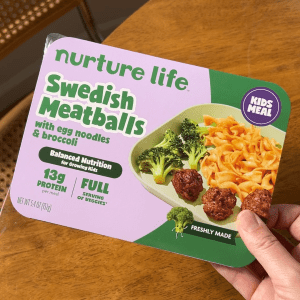
The Swedish Meatballs with Egg Noodles and Broccoli were an immediate hit, and the Beef Taco Pockets disappeared without a word of protest. The age-appropriate portion sizing worked well for both of my kids from a single order, which made me feel more confident that dinner would actually hold them over until bedtime.
Edge: Nurture Life. While both brands offer enough variety to keep kids interested, Nurture Life combines menu diversity with more satisfying portions, making it the stronger choice for everyday family dinners, especially for older kids and bigger appetites.

The Menu: Range
While we didn’t personally test Little Spoon’s purees for this review, they’re worth mentioning because they expand the brand’s overall offering well beyond the categories we evaluated. For families with children at different ages, that broader lineup can be a major advantage. Rather than switching services as kids grow, parents can find options tailored to multiple developmental stages under one subscription.
Nurture Life focuses on prepared meals for toddlers and kids rather than infant feeding. While the menu is extensive within that age range, it doesn’t offer the same breadth of offerings across developmental stages as Little Spoon.
Edge: Little Spoon. The addition of purees gives Little Spoon a broader overall product range and makes it an especially compelling option for families with younger children or kids at multiple stages.
Nutrition: Both Are Good. One Goes Further.
Little Spoon offers organic products for infants and babies, which may appeal to families with young children. However, the products evaluated here — Lunchers and Plates — do not carry USDA organic certification. Organic labeling also speaks to how ingredients are grown, not necessarily how well a meal is balanced for a growing child’s specific nutritional needs.
Nurture Life takes a different approach: every meal is dietitian-designed with macro balance calibrated to each developmental stage. Vegetables are incorporated throughout the menu and included in all lunch and dinner meals, while sugar and sodium are kept deliberately low — not as a marketing claim, but as a structural commitment built into the recipes.
That level of nutritional focus has earned real recognition: Nurture Life has won the Parents Best Food Award for “Best Kid Food” and was named a finalist in the 2026 NEXTY Awards, which honors innovation and integrity in children’s nutrition products.
Edge: Nurture Life. While Little Spoon emphasizes organic sourcing in some of its product lineup, Nurture Life’s age-calibrated nutrition, dietitian oversight, and industry recognition make it the stronger overall choice for parents.
The Picky Eater Test
Let’s not dance around it. This is the real test for most of us.
Andrew is my skeptic. If he can identify a vegetable with his eyes, he will remove it from the plate with surgical precision and push it to a separate corner as a warning to others. Olivia is a texture person — anything with an unexpected crunch or sliminess gets the face.
With Little Spoon Plates, the reception was reasonable. The Mac and Three Cheese was a winner. The chicken dishes were fine. Where things got rockier was with the more complex recipes — some Plates have eight or more visible ingredients, which is a lot for a child who views food diversity as a personal threat. The Lunchers were exciting for about two weeks before the novelty wore off, and the sauce portions relative to Plate sizes seemed unbalanced; you’d get more sauce than you could realistically use in one sitting.
With Nurture Life Kids Meals, the hidden-veggie approach is more deeply embedded across the menu. The mac and cheese sauce, the marinara, the meatball mix — the vegetables are genuinely hidden. Andrew ate butternut squash because it was blended into the Spaghetti & Meatballs with Super Veggie Sauce and he had no idea. That is a parenting win I will not be giving back.
Edge: Nurture Life, specifically for older picky eaters who’ve graduated from finger foods into a phase of aggressive negotiation.
Convenience: The 5pm Factor
Here’s the scenario: it’s 5:15pm. Both kids are hungry right now. I have 45 seconds before someone starts crying. What happens?
Nurture Life: Open the Kids Meal, transfer it to a plate, microwave for one minute, done. And, because Nurture Life delivers weekly, there’s always something in the fridge — no planning ahead, no freezing batches in advance, no scrambling on day 12.
Little Spoon: Also fast to heat up, but the Plates requires you to microwave the sealed tray so its FreshLock® film can steam the food. For parents who are conscious about heating food in plastic containers, the flexibility Nurture Life offers is a genuine differentiator.
Edge: Nurture Life for weekly delivery reliability and heating flexibility. The every-two-weeks schedule works if you plan ahead, but busy-parent reality doesn’t always cooperate.


Ease of Ordering: One Order vs. Multiple Accounts
This is something nobody talks about enough, and it’s the thing that quietly tipped the scales for me after about two weeks.
With Little Spoon, you sign up based on your child’s age and eating stage, and your account is then scoped to products appropriate for that stage. If you have an 8-month-old, you get baby food options. If you have a 5-year-old, you get Plates and Lunchers. But if you have both — or even a 2-year-old and a 4-year-old at meaningfully different stages — you can’t mix the two in a single account. The system doesn’t allow you to order, say, Babyblends and Plates in the same cart. To feed kids at different stages, you need to create separate accounts for each child.
Nurture Life’s approach couldn’t be more different. The whole system is built around one account, one box. You commit to a minimum number of items per week, and from there you have full access to the entire product range — Finger Foods for a 10-month-old, Kids Meals for a 6-year-old, smoothies, snacks — all in the same order. There’s no age gate restricting what you can put in your cart. You’re just shopping.
Edge: Nurture Life, clearly and without much contest. One account, one box, every age, every week.
Pricing: What You’re Actually Paying
Little Spoon ranges from $6.42 to $7.92 per meal with a $9.99 shipping fee per delivery. The brand also uses volume-based pricing, with larger orders lowering the per-meal cost. Its twice-monthly delivery schedule can help reduce shipping costs overall.
Nurture Life Kids Meals are $7.69 per meal and also include volume discount tiers that lower the per-meal price as order size increases – a meaningful advantage for families ordering for multiple kids. First-order discounts of up to 50% off are frequently available.
The honest comparison: despite Little Spoon’s advertised starting price, lower-volume orders can actually end up costing more overall. Nurture Life’s pricing remains competitive, especially at higher volumes, and its weekly delivery cadence may feel more practical for families who prefer fresh meals in regular rotation.
Edge: Nurture Life for overall value at higher order volumes and weekly availability.
The Delivery Experience
Nurture Life ships weekly throughout the U.S. (excluding Hawaii and Alaska) and meals arrive refrigerated in insulated packaging with ice packs. Everything is clearly labeled and ready to stack in the fridge. Kids Meal shelf life is 6–7 days refrigerated, and they can be stashed in the freezer for up to 90 days.
Little Spoon delivers every two weeks rather than every week. They also arrive fresh and refrigerated with reusable plates that are dishwasher-safe. Plates and Lunchers last up to 7 days refrigerated, which means you need to either freeze things in advance or be more disciplined about planning. On the weeks when I forgot to freeze a batch and hit day 12, I was back to scrambled eggs.
Edge: Nurture Life for delivery frequency.
The Verdict: Nurture Life Wins for the Everyday Family
Here’s my honest assessment after a month of both.
Little Spoon Plates and Lunchers are well-made products with genuinely impressive organic credentials. If organic certification is your top priority and you’re organized enough to manage a biweekly schedule, it’s a solid choice — particularly for younger kids who are still in the Plates sweet spot.
But Nurture Life Kids Meals are the winner for the kind of parent most of us actually are — someone with kids at different ages and stages, a 5pm that comes faster than expected, and no interest in running two separate meal systems. The age-appropriate portioning, the weekly cadence, the hidden vegetables my children genuinely did not detect, the coverage across breakfast through dinner — it solves a wider problem more consistently.
About the Author
Claire is a seasoned lifestyle writer and digital strategist who has spent over a decade navigating the intersection of wellness and high-performance careers.
Check Other Reviews

Turnout SSD Review: You’re 3x More Likely to Get Approved — Here’s How It Works

The Nurture Life Report: We Analyzed Thousands of Reviews So You Don’t Have To

I Tested Wunderground & RYZE Mushroom Coffees for 30 Days — One of Them Is Still in My Morning Rotation

The Lab Report: Why I’m Trading My Standard Brew for Wunderground’s 5,000mg Clinical Dose

0 Comments